
It’s been well over a year since I started playing MFL and somehow it’s still holding my attention just as much as it did in my first season – which is honestly pretty impressive.
I wanted to put together a quick reflection post on what I’ve learned over that time, partly for newer managers and partly because my own thinking on the game has changed a lot over the last year.
I’ve also updated my beginner guide recently, so if you’re just getting started, take a look at that too. And if you find any of this helpful, using my referral link is a nice way to support the content (plus we both get a small bonus).
This game is very sticky
I check MFL every day – usually multiple times a day. It’s sticky, and it’s deep.
What makes it work is the sandbox approach. You can play the game however you want:
- Be an owner, an agent, or a mix of both
- Build cheaply around ageing veterans
- Spend aggressively on wonderkids like Chelsea
- Obsess over tactics
- Or just set things up and casually check in
Over time, I’ve realised what works best for me. I’ve got a day job and I’m involved with other games too, so I can’t spend endless hours micromanaging. I like setting my squads and tactics up properly at the start of the season so I’m not sweating every tiny decision each day. Scouting new players is fun – and addictive – so I’ve got my own self-imposed spending limit per season.
I’ve also found that three clubs is probably my limit. Any more than that and I’d be speed-running replays and losing some of the immersion that makes the game fun in the first place (and I think my bank balance would struggle too!)
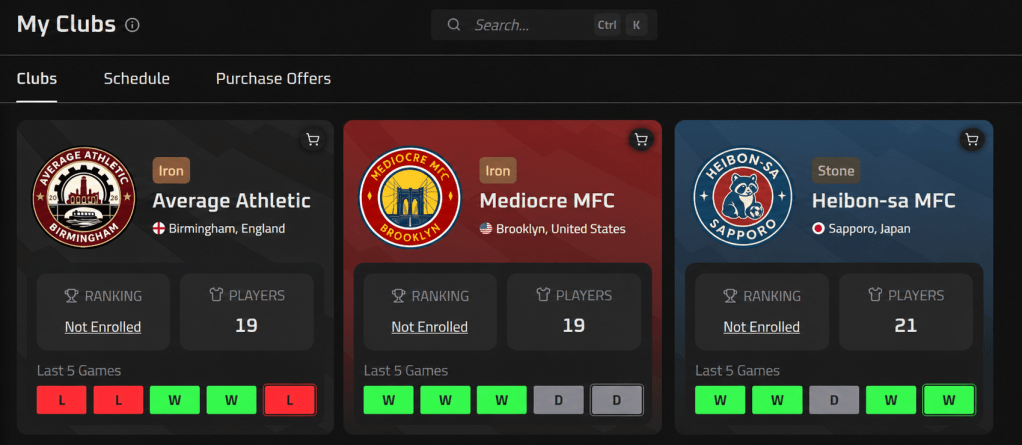
The higher you climb, the harder it gets
Obvious point, but worth repeating: once you move beyond Stone, the game changes.
Managers take things much more seriously. Competition for players gets fiercer. Finding genuinely good talent – especially Rare players – becomes significantly harder (and with power-creep, that means it’s getting harder in Ice and Stone too).
I’ve got two clubs in Iron next season and, honestly, I’m bricking it. There’s every chance they go straight back down. But I’m here for the fight!
Scarcity is built into the MFL model, which is great, but you really start to feel it at higher levels. The common wisdom is to sell reward packs unopened because they’re usually worth more as guaranteed cash than gambling on ripping a 27-year-old, 5’5″ goalkeeper.
But personally? I still rip most of mine.
Partly because it’s fun! But mainly because scouting the exact profiles I want – high all-rounders with long-term potential – has become increasingly difficult. Sometimes taking the gamble feels like the only realistic route to finding players I actually want to build around.
I’m also a big fan of young 73–74 rated Uncommons. If they progress well, they can eventually become genuinely valuable Rare-level players. And seeing that progression is one of the things that keeps me coming back to MFL, day after day.
Fitness probably isn’t linked to physical stats
MFL says players with high physical stats tire more slowly because the ‘handle the load better’.
I’m about 99% convinced that isn’t actually true.
I’ve always prioritised decent physical ratings, but in practice I’ve found fatigue feels far more random than expected. Some players seem able to play forever, others tire constantly, and I’ve never seen consistent evidence that higher physical stats meaningfully improve recovery.
Age definitely matters – especially for players carrying retirement flags – but I suspect there’s also some hidden age-related decline even before those flags appear.
This probably won’t massively change how I build squads, but it has changed how much I trust physical stats when scouting new signings and planning squad rotations.
I’m convinced momentum exists
This might be tinfoil-hat territory, but I’m increasingly convinced MFL has some kind of hidden momentum system behind the scenes.
In real football, momentum swings are everywhere. A team goes behind and suddenly starts piling on pressure. Clubs that scrape together a couple of wins suddenly go on long unbeaten runs. Confidence clearly matters in real life, even if it’s hard to quantify.
And honestly? MFL often feels the same way to me.
I’ve noticed a pattern over multiple seasons where my teams tend to start slowly, grind through the first few matches looking half asleep, and then suddenly click into gear later in the season and go on a run – similar to how Man City tend to warm up after Christmas.
Maybe it’s randomness. Maybe it’s fixture difficulty. Maybe it’s just confirmation bias because humans love spotting patterns. But I’ve seen enough strange swings in form – both positive and negative – that I’d be surprised if there wasn’t some kind of hidden morale, confidence or momentum mechanic influencing things in the background.
Is that just me or has anyone else noticed that?
Squad size matters
I’ve gone back and forth on this over the year. Originally I thought 21 players was the sweet spot. I don’t anymore.
For me, 19 players is probably ideal – if the squad is constructed properly. That means:
- Some players who can cover multiple positions (other than strikers, I try to avoid single-position outfielders)
- Formations that naturally overlap
- And a clear plan for rotation
With a minimum of roughly 28 matches per season (22 league games plus around 6 cup games), a 19-player squad gives all your outfield players a decent share of starts while still allowing your most important players to hit high appearance numbers for 100% progression.
And honestly, the progression gap between a player appearing in 80% of matches versus 35% isn’t as dramatic as people think because training contributes so much anyway. The bigger issue is succession planning.
A 22-player squad means finding, replacing and managing three extra players every season – and at higher levels, that becomes increasingly difficult and/or expensive
One caveat: if you’ve got orange or red retirement-flag players, I’d exclude them from your squad count because they usually can’t handle the same workload reliably.
Progression is mostly unpredictable (and that’s a good thing)
Succession planning really matters in MFL. Rollover day can be brutal when a star player suddenly decides to retire and your entire long-term plan explodes overnight.
That’s why I make heavy use of the watchlist to keep an eye on players I might want to bring in to fill the gaps. Not always for buying immediately, but sometimes for tracking progression trends over time as it’s the easiest way to see this and good progression is a strong buy signal for me.
The unpredictability of progression is one of the best systems in the game. You can’t fully “solve” it but, in my experience, players who suddenly start progressing strongly are more likely to keep progressing than players who’ve flatlined for multiple seasons. I’ve definitely hit a few gems that way.
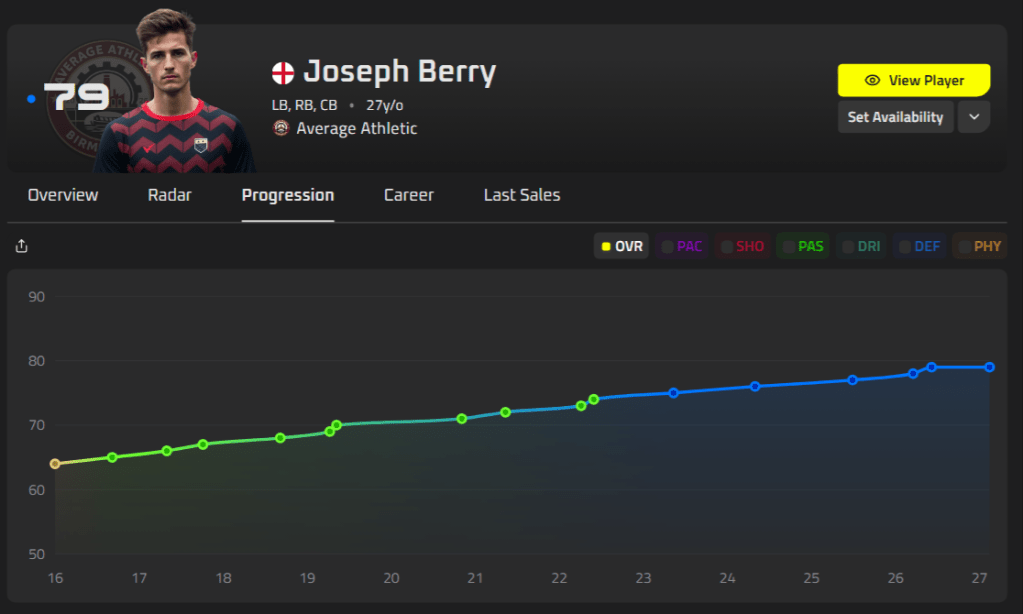
That’s also why buying freshly packed players is such a gamble – you’re effectively buying blind because there’s no development history to analyse yet.
And, because MFL enjoys chaos, don’t be surprised if your 33-year-old midfielder who’s gained +1 across his entire career suddenly decides to turn into prime Luka Modrić the moment he announces his retirement. That unpredictability is frustrating sometimes, but it’s also a huge part of what makes the game interesting.
You can absolutely play this solo
When I first started writing about MFL, I thought networking with other managers was essential. A year later, I’m less convinced.
My life got busy, I became less active in Discords, and these days I mostly play the game solo – and honestly, that’s completely fine.
I still enjoy it. I still progress. I still get invested in my clubs.
The social side definitely helps, especially if you rely heavily on loans or regularly negotiate transfers, but it’s not mandatory to enjoy the game – especially since simple additions like transfer-offer comment boxes have made solo play easier than ever.
Final thoughts
The biggest thing I’ve learned after a year of MFL is that there isn’t really a ‘correct’ way to play it.
There are over 5,000 managers in the game now. Some treat it like a hardcore spreadsheet simulator, while others play more casually. Some enjoy playing with one club and a tight set of players, other like to build an empire. And now that we have club delegation, some managers hand their clubs over to other people to look after – a fully hands-off approach. The game supports all of this.
I’ve had promotions, relegations, cup runs, lucky pack pulls, ageing squads, panic rebuilds and seasons where everything fell apart but that unpredictability is what keeps the game interesting for me.
A year in, I still look forward to logging in every day. And honestly, that’s probably the best compliment I can give the game.
If you’re into this sort of thing, I’d strongly recommend you give it a try.

