
MFL is growing. Spark, the lowest division in the current pyramid structure, is almost full. Over 5,000 clubs are active in Season 6, and new managers are still joining on a daily basis. So what happens next?
Well, here’s the thing: the current pyramid wasn’t built for long-term growth. If MFL is serious about becoming a major football management game that can eventually support tens of thousands of clubs, something has to change.
So what does that look like? I think there are a few options… so grab a cuppa and let’s go over them!
First, the current structure (and why it’s clever but limited)
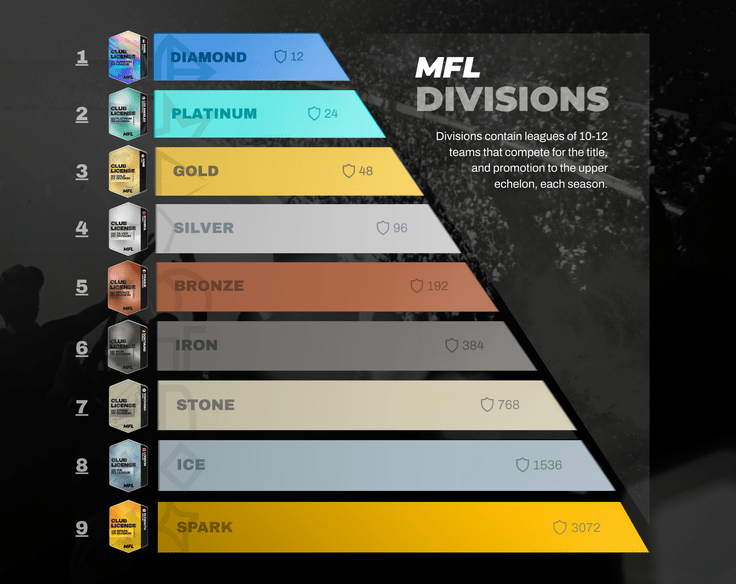
To set the scene, MFL currently runs a 2:1 pyramid across nine tiers, from Spark up to Diamond. Each division has 12-team leagues, and each higher division has half as many leagues as the one below. Users can own multiple teams within a division, but not within the same league. Promotions and relegations are handled via a mix of automatic slots and playoffs with an average of 1.75 clubs promoted to the next division each season, and 3.5 clubs relegated.
Just like in real football, rewards scale upward. The winner of a Stone league gets 10,500 $MFL, while finishing first in Spark earns just 2,400. For context, a common player costs around 600 $MFL, and they’re usually… not great.
Currently, this structure supports:
- 3,072 clubs in Spark (the entry division, now nearly full)
- 6,132 clubs total
So the big question is: what happens when we hit capacity?
Option 1: Switch to a 3:1 pyramid
This option keeps the existing structure but increases the number of leagues feeding into each tier. Instead of each division having twice as many leagues as the one above, it has three times as many.
That expands capacity to over 117,000 clubs with no new divisions needed.
| Tier | Number of leagues | Number of clubs |
|---|---|---|
| Diamond | 1 | 12 |
| Platinum | 3 | 36 |
| Gold | 9 | 108 |
| Silver | 27 | 324 |
| Bronze | 81 | 972 |
| Iron | 243 | 2,916 |
| Stone | 729 | 8,748 |
| Ice | 2,187 | 26,244 |
| Spark | 6,561 | 78,732 |
| TOTAL | 9,841 | 118,092 |
👍 The good:
- Massive scale without changing the basic ladder – the new format can be rolled out immediately, moving clubs up divisions as required to shrink the structure, with lower divisions added back when there is enough demand.
- Rewards early users with an immediate jump up the pyramid – current Spark teams would jump straight into Stone – a nice bonus for being early!
- Keeps the unified ‘world league’ structure intact – no change to the game’s narrative.
👎 The problems:
- Progression gets slower – with more leagues feeding into fewer slots, the chances of promotion shrink dramatically. You could spend a dozen seasons in Spark.
- Reward dilution – the prize pool would need to balloon to support 20x more leagues – or be spread thinner, which could make all but the top divisions feel unrewarding.
- Mismatch between players and leagues – the current generation of different rarities is finely tuned to the existing structure so that would need to be quickly changed to fit the new structure.
Option 2: Introduce regional federations
Instead of stretching the global pyramid, MFL could build parallel pyramids by region, such as:
- Europe Federation
- Africa Federation
- Americas Federation
- Asia-Pacific Federation
Each region would have its own 2:1 structure, its own Spark division, its own rewards, but still share the same engine, same transfer market, and same gameplay. This is the option that MFL have previously hinted is the most likely way forward.
👍 The good:
- Fairly easy to implement — clubs already have global locations so moving them into regional federations shouldn’t be too difficult?
- Creates potential for inter-federation events (Champions League-style cups) – this would add a fun new dynamic into the game.
👎 The problems:
- Requires some backend work on the game loop and the UI for federation separation to work – even if this is easy enough to implement, it’s definitely not a quick fix.
- Could feel fragmented if not framed well, and some long standing rivalries between clubs would be lost.
Option 3: Add a new division below Spark – ‘DUST’
This is the simplest fix: add a 10th tier, which I’m going to (ironically) call ‘Dust‘. This gives room for 6,144 more clubs competing across an extra 512 leagues.
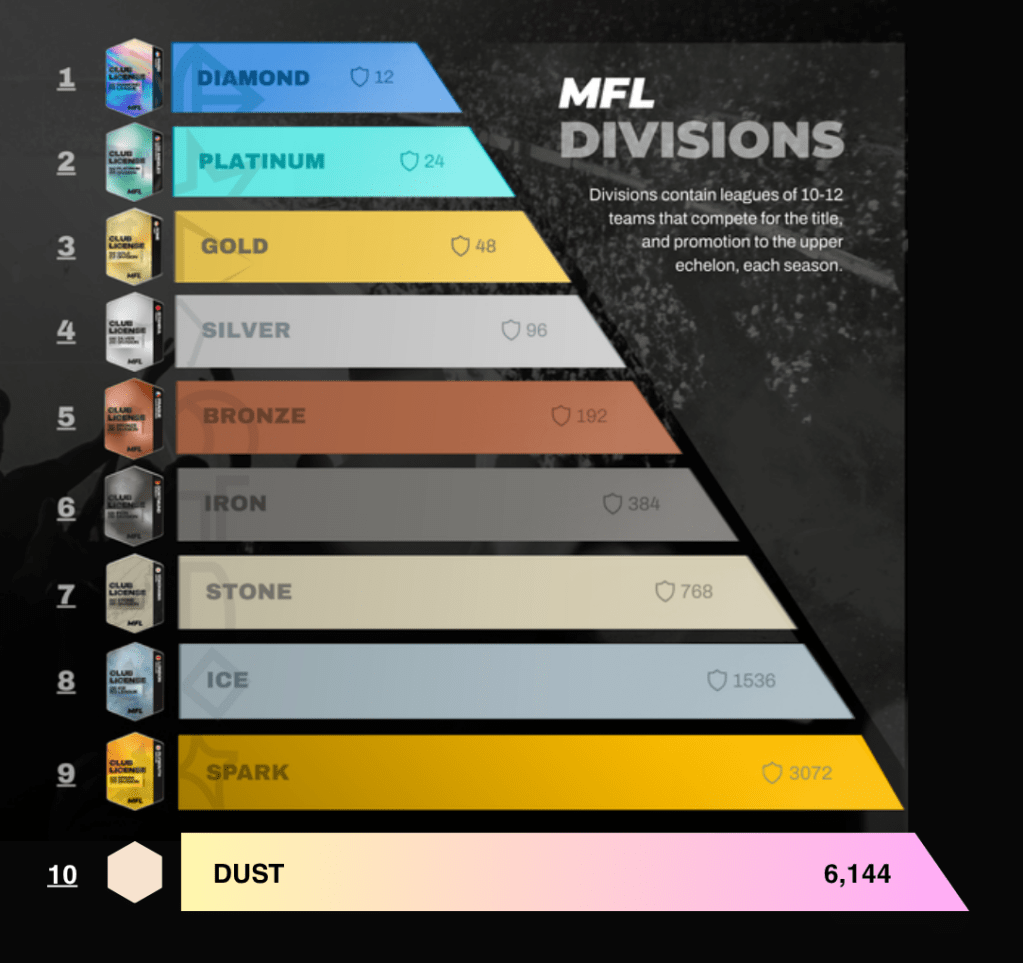
Dust becomes the new starting point in the game. A gritty, low-reward proving ground where sub-50-rated players and rookie managers can cut their teeth.
👍 The good:
- Easy to implement – the simplest solution.
- Buys time – supports another 1–2 years of growth at the current pace while the team work out the best way forward.
- Could be themed as semi-pro / grassroots / youth-level to add to the narrative.
👎 The problems:
- Rewards will be tiny – winning a Dust league might earn just 1,000 $MFL — barely enough to buy one low-rated common, and most users won’t even make that much.
- Not exciting for new users – starting with junk players and no real path to progression or rewards could be off-putting unless it’s positioned well.
- Might require tweaks to player generation. Right now, the average player rating in the game is 54 and rising. Dust clubs might not be viable unless MFL changes how many weaker players are generated – or it just becomes a carbon copy of Spark in terms of average team ratings (but with half the rewards).
Still, as a short-term release valve, Dust might work – especially if it’s limited in scope and clearly messaged.
SIDE NOTE: Could Dust Be Cheaper?
If MFL adds a tier below the current structure, it would be tempting to sell the club licenses at a lower price. After all, $80 is a lot to ask for a club that will likely manage a bunch of 46-rated defenders with dodgy fitness and two left feet.
But that comes with a trade-off. Cheaper clubs could undermine the perceived value of existing Spark licenses. That’s a big deal – especially in a Web3 game where early adopters might also consider themselves investors.
One solution? License upgrades. Maybe Dust clubs cost $40 to start, but must pay the $40 difference if they get promoted to Spark – a bit like the costs a non-league Club might incur as they move into the professional divisions.
Or perhaps MFL adds sone restrictions to Dust clubs – like limited market access, loan limits, or player caps – to make them clearly ‘starter-tier’ without stepping on Spark’s toes.
Still, neither of these options are ideal, particularly with promotions and relegations making the game so fluid. I do think MFL would benefit from a cheaper entry point or a true ‘free to play’ option, but not at the expense of long-term trust, so this needs careful handling.
A blended way: phased rollout of federations (starting with dust)
The most realistic path forward – especially given MFL’s current pace of growth – might be a phased rollout of regional federations, starting with Dust.
Phase 1: Launch Regional Dust Divisions
- Create three Dust federations (e.g. Europe, Americas, Asia and Africa).
- Each Dust federation has its own leagues and reward pool.
- 3:1 promotion from Dust → global Spark.
- Lower entry cost is justified by lower rewards + tougher progression odds – so Dust licences could be cheaper in this structure (and might attract existing users wanting a new challenge).
- As part of this phase, player generation is adjusted to ensure the balance is right and enough sub-50 rated players are available to support the new Dust federations.
Phase 2: Regionalise Spark and Above
- As club numbers grow, gradually regionalise Spark to Diamond into separate full pyramids
- Keep rewards and gameplay consistent, just split by region
- Begin inter-federation communication and branding
Phase 3: Introduce Global Competitions
- Add tournaments that bring the best from each federation together:
- Champions League-style knockout
- Club World Cup format
- Other Federation vs Federation rivalries
This model allows MFL to scale cleanly, test ideas regionally, and only expand when there’s demand. Using the 3:1 ratio means MFL can accommodate up to another 9,216 clubs immediately – more than doubling the current structure. And it gives Dust a real purpose — not just as an entry point, but as the first federated tier of the MFL universe.
An alternative to this would be to turn Spark into the first regional federated tier. This would be cleaner but buys less time (it only adds ~1,500 licenses), and would mean changing the goalposts for existing Spark clubs with the 3-1 promotion and relegation structure – which might be unpopular.
Final thoughts
There’s no urgent crisis here – but there is a decision to be made, and soon.
3:1 is powerful but rigid. Tacking a tenth division to the bottom of the pyramid is simple but underwhelming. A federated model, rolled out gradually, might be the most future-proof answer – and blending that with a lower, grassroots tier, gives MFL the perfect excuse to test it.
Lastly, this is just my take on things. I’ve tried to be accurate with numbers and structure but if I’ve got anything wrong, or you have a better idea, I’d love to hear it!
 MDJ
MDJ 
Insightful and interesting blog! Just curious though… what does the regional federation approach (option 2) solve other than just realigning the existing teams? Or is option 2 really only in play with the addition of more teams? In my view, Option 2 in isolation doesn’t seem to address any future growth problems, unless I am missing something.
LikeLike
Thanks!
Maybe it wasn’t clear but the regional structure in my mind means re-creating the current structure but across multiple regions, therefore increasing capacity by two or three-fold (or more) depending on how many separate regions are created. I think they’ve hinted at some sort of regional structure in the past but obviously that’s a big change to make so I’m not sure how they’ll approach it, if they do go down that road.
LikeLike