
MFL (Metaverse Football League) is more than just a football game – it’s a football ecosystem. Built on the blockchain and inspired by classic football management games, MFL gives you full ownership over your club and players, and the freedom to play your way.
MFL have published a whitepaper about the game to help people understand the thinking behind it and the intricacies of the gameplay. It’s a must-read for anyone starting out.
Not had time to do that yet? I’ve got you covered! Whether you’re eyeing silverware or scouting for future stars, here are five things you really need to know from the whitepaper before you get started.
1. Choose Your Role: Club Owner, Agent, or Both
The first thing to know is that there are three ways to play MFL:
- Club Owner: You manage a team of players, set tactics, train your squad, and compete in leagues and tournaments. You’re the gaffer – and also the club CEO.
- Agent: You don’t manage a team, but instead own players and lease them out to clubs. You focus on scouting, development, and profiting from your players’ success.
- Club Owner + Agent: Many people choose to do both. You can develop talent, field a squad, and rent out surplus players to other clubs for passive income.
This flexibility makes MFL more than a one-track experience. You can switch focus as your collection or strategy evolves. Enjoying managing one club? Why not buy another and use it as a feeder club to develop up-and-coming youngsters?
Clubs compete against each other in a league format. This is a pyramidal structure with multiple divisions with promotion and relegation. Each division is made up of leagues containing 10-12 teams. Clubs also compete in tournaments like the IMFF Cup.
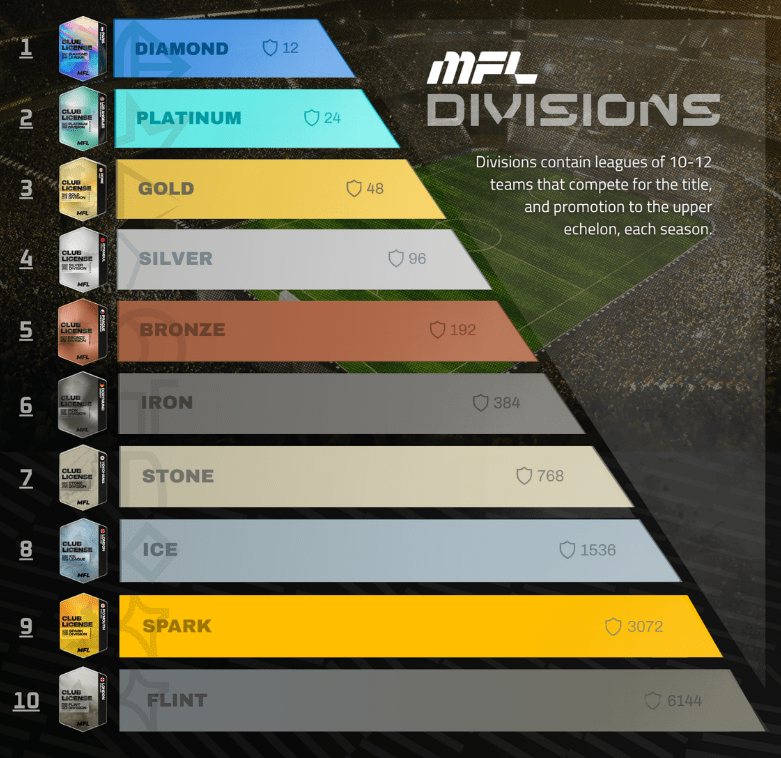
Starting out as a Club Owner means a fairly hefty initial outlay ($80 at the time of writing) but after that you can loan all of your players in for free if you don’t want to stretch any further than that. As a new user you can buy up to three Starter Packs containing two players for $10 each, so that’s a good way to start off as an Agent on a lower budget.

If you use a referral link to sign up, you get a free player after you spend $25 in the game so that’s a nice boost you don’t want to miss out on.
2. $MFL – the currency that powers the game
MFL Coin ($MFL) is the in-game currency, which you can earn by competing with your club and/or by signing your players to contracts at clubs owned by other owners and taking a cut of their rewards.
$MFL is an in-game currency only – it’s non-withdrawable and has an unlimited supply. You can use $MFL to buy player packs in the MFL store to improve your squad. In the future, there are likely to be other in-game assets that can be bought for $MFL.
The whitepaper tells us that 800 $MFL is equivalent to $1 in value in the MFL Store but it’s worth noting that the real ‘exchange rate’ is more like 250 $MFL to $1, based on what packs are currently selling for on Flowty.
One thing to note is that the circulation of players is controlled tightly in the game so it takes time to accumulate enough $MFL to buy packs and, outside of that, there are only two player pack drops per season where you can buy packs with real money – and they sell out in seconds. You don’t need to wait for packs though – you can also buy players from other users via the in-game marketplace or on the external Flow marketplace, Flowty.
Running your club on a tight budget? You don’t have to buy your players – you can loan them in from other Agents in the game. This will usually mean giving up a percentage of the your club’s $MFL earnings in exchange for their services so it’s important to keep an eye on how much you’re giving away and any minimum appearance clauses you need to meet.
3. Player Attributes: It’s More Than Just a Rating
Each player in the game is uniquely generated with random traits and statistics. The players are dynamic assets that evolve during their careers in the game – and your interaction with them shapes that evolution.
Each player has a primary position. Some will have secondary positions too. Players generally perform slightly better when playing in their primary position than one of their secondary positions but this isn’t always the case, especially as their attributes evolve over time.
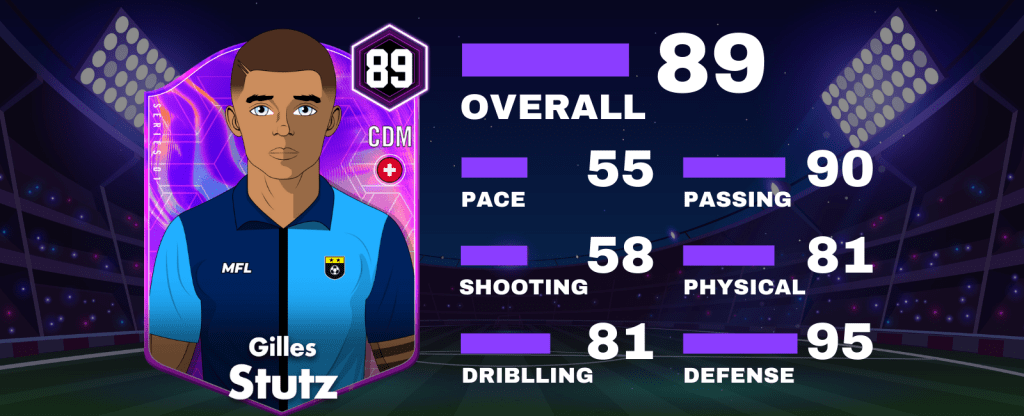
Each outfield player in MFL has a set of six core attributes:
- Pace, Passing, Dribbling, Shooting, Defence, Physical
Players are assigned a rating for each attribute from 0 to 99 when they are minted (born) in the game. These are combined to create an Overall rating. Depending on the Overall, the players slot into 6 different rarity tiers, from Common up to Ultimate.

But here’s the kicker: the Overall isn’t just a flat average. It’s weighted depending on the player’s position. For example:
- A Centre Back will have more weight given to Defence and Physical.
- A Winger’s rating will be more influenced by Pace and Dribbling.
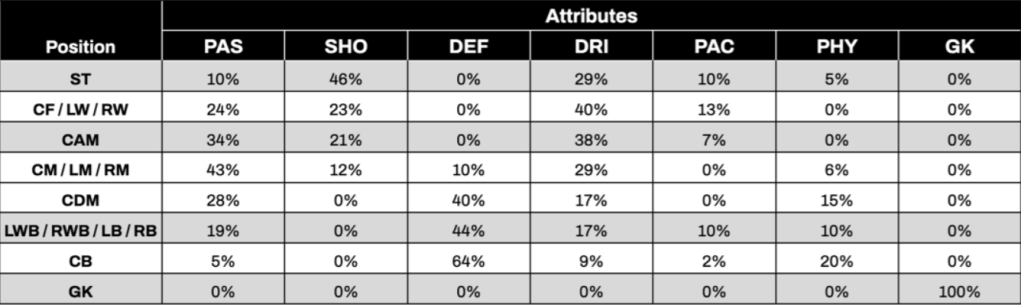
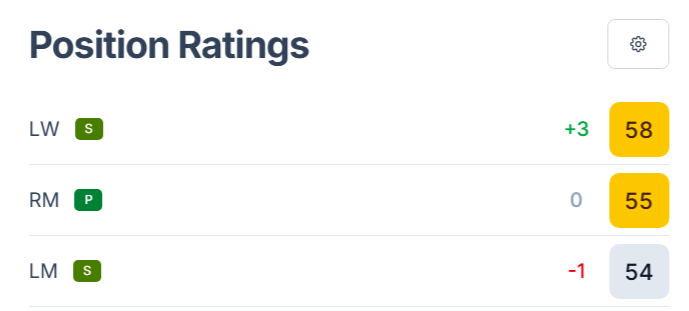
This means a player might have a lower Overall but still be perfect for your system – if their key stats suit their position. It also means that as player attributes evolve, they might become more suited to positions outside of their primary position. It’s hard to see this in the game because their player card doesn’t change but if you put their player ID into mflplayer.info you can easily check this.
There are some hidden attributes too – longevity and potential.
- Potential represents the highest possible Overall rating a player can achieve. Players with a higher Potential rating will be able to improve at a faster pace. Players also have a ‘prime age’ when their development peaks, which means the progression curve looks different for different players.
- Longevity relates to how long a player may maintain peak performance before their abilities deteriorate. All players retire sometime between 32 and 42 years old and players with a high Longevity rating will retire later. The average age of retirement is 35.
You can’t see these attributes, they’re hidden in the blockchain, which means people can’t just ‘hack’ the game by buying up all the youngsters with the most potential early on.
Note that players have physical traits too – height (which has a very small impact on aerial duels and goalkeeper dives) and left/right footedness (which has no impact currently).
4. Formations and Tactics Matter
Like any good football management game, in MFL, your formation and tactics affect how your team performs. You’ll need to consider:
- Formation Fit: Do you have the players for a 4-3-3, or are you better off with a back three and wingbacks? Which roles are going to be more useful to you across different formations?
- Player Roles: Can your attacking midfielder drop into deeper roles, or will they be wasted in your system? Do you have players that play better outside of their primary position?
- Flexibility: Some players can slot into multiple positions, giving you more options and better squad depth which can be helpful to support rotation across a full season.
Picking the right players is only half the battle – setting them up to win is the rest. You can already go pretty deep into this in the game – with 25 different formations to choose from, team instructions and individual player instructions too – but expect even more to be added into this soon.
Want your centre backs to go up for every corner? Give them positional freedom. Got a striker with high shooting ability? Why not ask them to take more long shots and roll the dice?
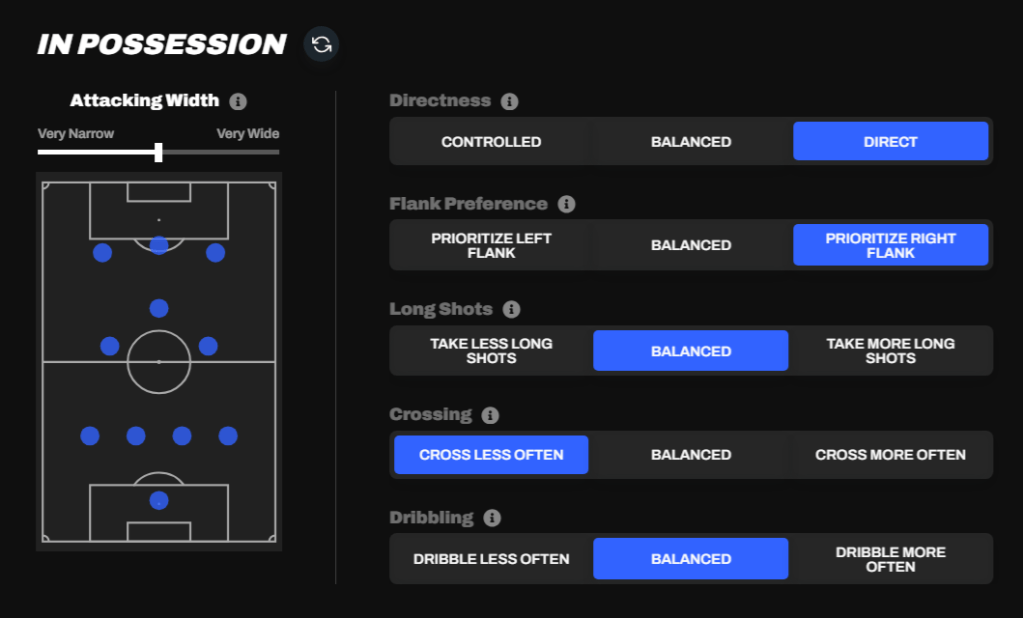
Note – there are no substitutes in MFL, yet. So you only need to worry about your first eleven when you’re setting up for matches. Injuries also aren’t a factor yet, but suspensions are, so watch out for red and yellow cards!
5. Progression: Training, Playing, and the Team Average
MFL isn’t just about collecting players – it’s about developing them. This is where things get really interesting!
- Players improve through training and match experience – they gather XP through both of these.
- Progression through training is influenced by a player’s Potential, Longevity, and your club’s training efficiency.
- Match progression is influenced by the number of matches they plan, the overall average of the opponents, and also the players’ performance on the pitch.
Let’s break this down a bit more…
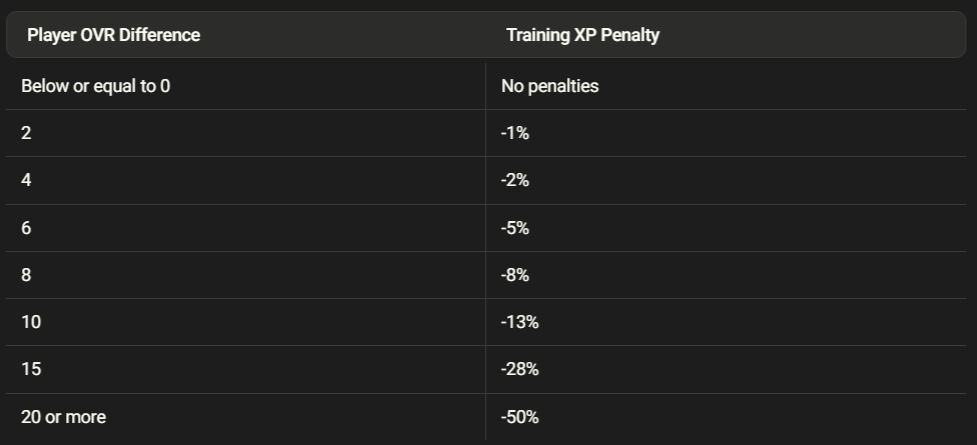
To train players efficiently they need to be tested in training, so they need to be with players of a similar – or better – rating to them. This means that the XP a player earns from training is adjusted based on their Overall rating compared to the average Overall of the top 16 players on their team.
If a player’s Overall is significantly higher than the team’s average, they will experience a reduction in their training XP, as shown in the table below:
There is a similar dynamic at play in match progression. For each player, the Overall rating at their primary position is compared to the average Overall of the opposing team. If a player’s Overall exceeds the opponent’s average, they incur a penalty to their match XP. This helps to keep divisions balanced as it encourages Club Owners to loan out their over-powered players to clubs in higher divisions.
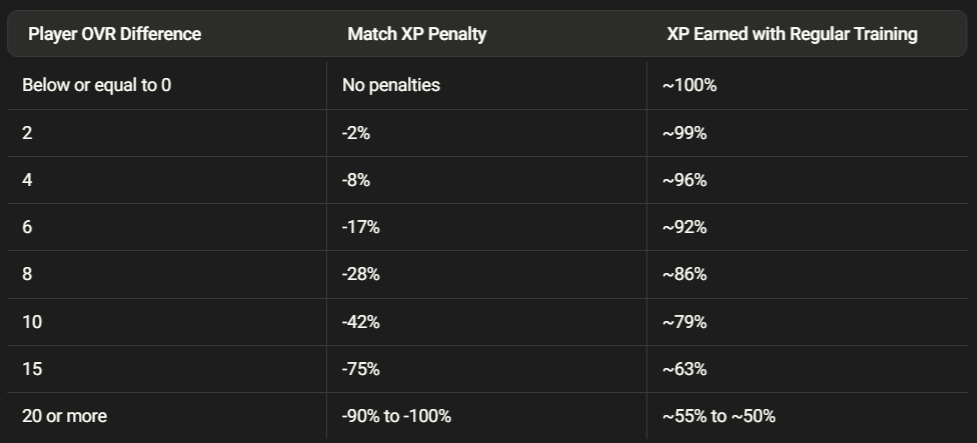
Match progression is also affected by the player’s performance on the pitch – players with high match ratings get bonus XP, while those with low ratings see reduced XP earnings. Players obviously need plenty of time on the pitch too – warming the bench all season will hamper their progression.
Note that progression gets slightly harder when players make the jump between rarities tiers, so it’s harder for a player to progress from 64 to 65 (Limited to Uncommon) than from 63 to 64.
Training and match progression relies on players being at a club. For those that don’t, the MFL Development Centre is a place they can continue their training and development – but it comes at a cost and it means they’re locked in for a least one season.
All of this creates a layered progression system. It’s not enough to just grind – you need to build a strong foundation and balance short-term success with long-term growth. And, if you’re an agent, where you place your players really matters.
Final thoughts
MFL is still early in its journey, but it’s already packed with depth, strategy, and potential. And the best part? The game is evolving fast – so if you’re thinking about jumping in, now’s a great time to start building your club. Hopefully this helps you to get a solid start!
See you in the game!
 MDJ
MDJ 
One thought on “Beginner’s guide to MFL: 5 key insights from the whitepaper”